

Network Models for Assessing the Co-occurrence Between Stuttering and ADHD
Abstract
Background and Aims Previous studies have indicated that people who stutter (PWS) and people with ADHD (PWADHD) show similar cognitive profiles, implying a link between the two neurodevelopmental profiles. This study examined the relationship between stuttering and ADHD and investigated the extent of this similarity using Network Models (NMs).
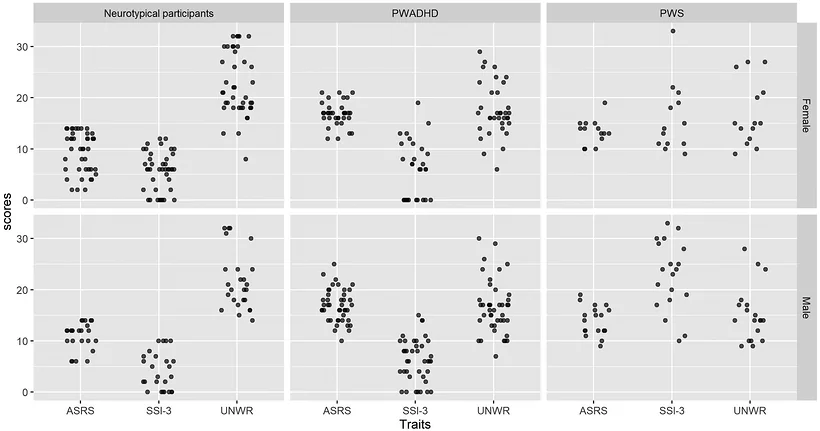
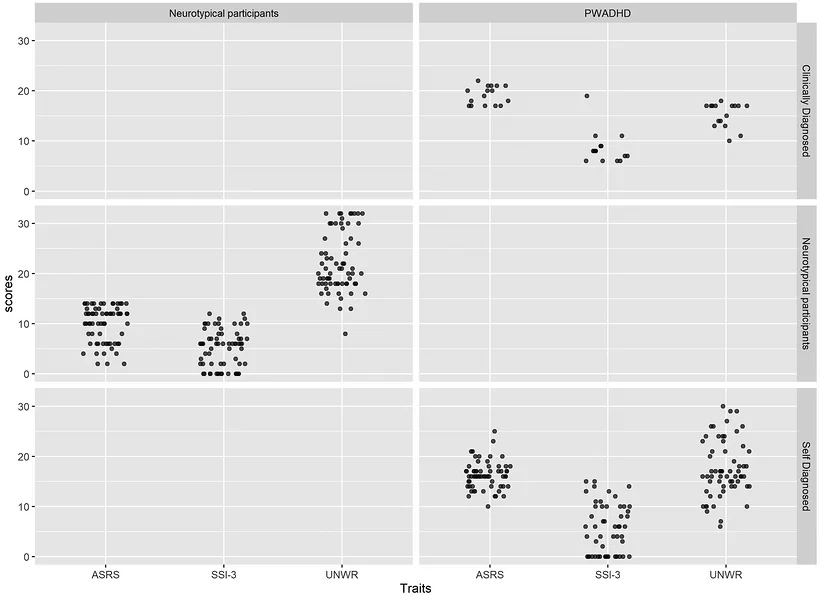
Methods and Procedures Neurotypical participants (people who did not stutter and did not have ADHD; N = 67), PWADHD (N = 79) and PWS (N = 33) were assessed for stuttering, ADHD traits, and phonological working memory (PWM). Lower PWM is associated with many conditions including stuttering and ADHD.
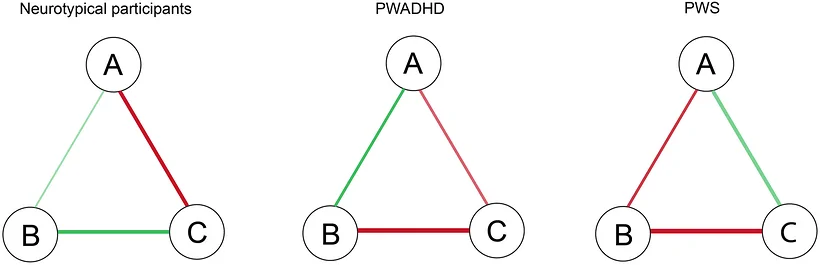
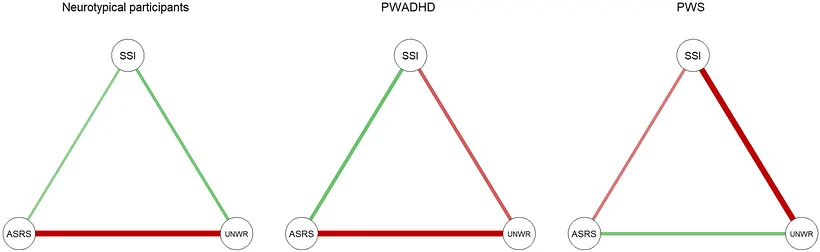
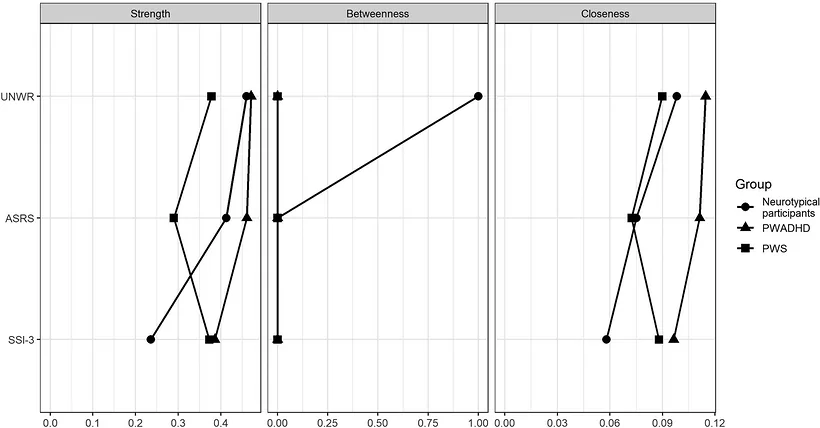
Outcomes and Results NM analysis revealed differences in cognitive networks (fluency, attention and PWM) between participant groups. The findings suggest partially different cognitive architectures across participant groups indicating that stuttering and ADHD do not share a common underlying mechanism. There were marked differences between participant groups in the way that traits of attention, stuttering, and PWM linked with each other which emphasises partially unique cognitive architecture of these participant groups. Higher PWM scores were associated with better attention in the neurotypical group and PWADHD but not PWS. Higher stuttering characteristics affected PWM in PWADHD and PWS, but the link was stronger in PWS. Whilst higher stuttering characteristics correlated positively with lower attention in PWADHD, the opposite was the case for PWS. PWM was the most important factor in all groups but the way it affected other cognitive processes differed between neurotypical participants, PWS and PWADHD.
Conclusions and Implications Overall NM structures were similar between the neurotypical group and PWADHD but they both differed from those of PWS. Findings argue against a shared underlying mechanism of attention, fluency and PWM in stuttering and ADHD and highlight the importance of including PWM assessments within a network-based framework.
What This Paper Adds
What is already known on this subject
Existing research indicates that people who stutter (PWS) and people with ADHD (PWADHD) exhibit overlapping traits in attention, speech fluency, and phonological working memory (PWM). Past studies have reported lower performance in attention, speech fluency and PWM in PWADHD and PWS as compared to neurotypical participants. This trait overlap has often been interpreted as co-occurrence between the two profiles (stuttering and ADHD). However, existing literature has primarily relied on trait co-occurrence and group-level performance differences, without examining whether attention, fluency, and PWM interact in similar ways across the two profiles. As a result, it remains unclear whether these shared traits reflect common underlying mechanisms or distinct cognitive profiles that show similar behavioural outcomes.
What this study adds to existing knowledge
The present study showed that although attention, fluency, and PWM differ between neurotypical participants versus PWS, and PWADHD, the way these abilities are interconnected differs between groups. Network analyses revealed partially distinct patterns of association, with the PWADHD network more closely resembling that of the neurotypical participants than that of PWS. Whilst PWM was a central component across all groups, its role within the network varied. In neurotypical participants and PWADHD, PWM was closely linked to attention, but this link was lost in PWS. These findings indicate that similar trait profiles do not necessarily imply the same cognitive architecture, and that overlapping traits in stuttering and ADHD can arise from different patterns of interaction among attention, fluency and PWM rather than from a shared underlying mechanism.
What are the actual clinical implications of this study?
Our findings suggest that overlapping traits in attention, speech and PWM should not automatically be interpreted as evidence of a shared underlying profile in stuttering and ADHD. Instead, clinical evaluation should consider how cognitive processes interact within each profile. The results also highlight the value of including PWM assessment when examining attentional and fluency traits in both PWS and PWADHD, particularly using tools such as the UNWR. More broadly, network-based approaches offer a promising framework for distinguishing between surface-level trait overlap and fundamental differences in cognitive organisation, thereby supporting more precise, profile-specific intervention strategies.
Figures
Published figures from the open-access version on PubMed Central (CC BY 4.0).
Video
Publication Details
Links
Suggested Citation
Kazazi, F., & Howell, P. (2026). Network Models for Assessing the Co-occurrence Between Stuttering and ADHD. International Journal of Language & Communication Disorders, 61(5). https://doi.org/10.1111/1460-6984.70320